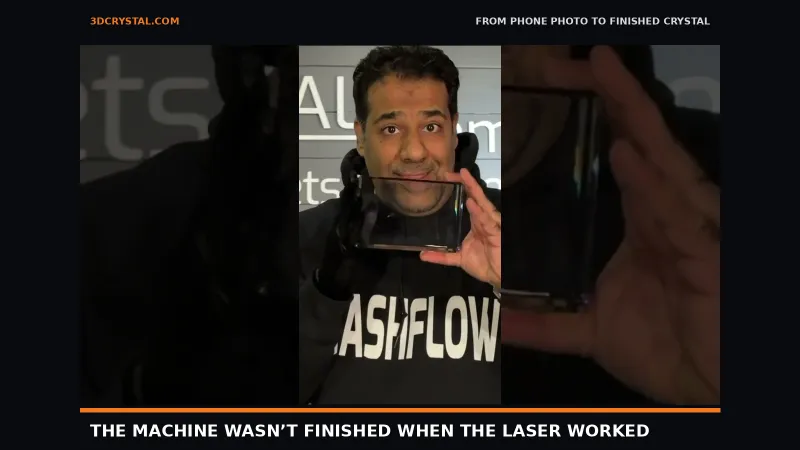


A proposed CN Tower souvenir began with a store walk—and a lesson: the product is not finished until a buyer can display, test and reorder it.

Riyaz Datoo’s retail pitch began with a practical question: where could the crystal be lit and displayed?
Before Riyaz Datoo walked into a meeting about a custom CN Tower souvenir, he walked the store.
He had already chosen three possible places where the crystal might be displayed. One practical requirement shaped the search: access to electricity. The piece was meant to sit on an illuminated base, and an unpowered display would leave much of its depth hidden. The smallest detail in the pitch—the location of a plug—carried the largest lesson.
A custom gift does not enter the world alone. It arrives with a shelf, a staff member, a price label, a replenishment decision and a few seconds in which a visitor decides whether to stop. Designing the object is only the beginning. The last inch of the work is designing how the object meets the room.
The image had to belong to the place
The proposal started with a clear visual idea: build a dimensional image of the CN Tower inside crystal, with tonal detail and clouds helping the landmark feel rooted in its setting. A generic sample might demonstrate the technique. A landmark-specific piece could show a buyer what the souvenir would mean in that particular shop.
That distinction matters at a destination. The CN Tower’s current Shop describes a mix of local design and distinctive tower memorabilia. In that environment, a souvenir has two jobs. It must be recognisable as part of the place, and it must earn attention among many other reminders of the same visit.
For the visitor, the object offers a compact way to carry the landmark home. For the retailer, however, emotional relevance is only the opening argument. The object also has to work as merchandise.
A beautiful object can still be a difficult product
Datoo’s preparation moved quickly from image-making to the buyer’s daily reality. His plan was to explain how the product could be ordered in a manageable test quantity, how labels and UPC codes could arrive ready for the shelf, and how the display could help a customer understand the crystal without a long explanation. These were parts of a historical pitch plan, not a claim about the outcome of the meeting.
The point was to remove small burdens before they became reasons to say no. A buyer evaluating a custom souvenir is also evaluating receiving, storage, staff time, presentation and the risk of a slow first order. None of those concerns makes the object less creative. They determine whether the creativity can survive contact with a real store.
That is why a prototype or digital preview can do more than show the artwork. It can give both sides something specific to question: Is the landmark legible at this size? Does the inscription compete with the image? What kind of base suits the display? Where will the power cable go? The preview turns taste into a conversation about decisions.
The last inch of design is the shelf
Inside crystal, light is functional. It helps reveal the laser-engraved points and the sense of depth they create. Datoo put it simply: “Light gives the product life.” 3DCrystal’s own merchandising guidance makes the same practical case for illumination, placement and letting people handle the object.
But the store walk adds something that a display checklist misses. Datoo was not merely prescribing a light base from afar. He had gone to the place where the proposed product would have to work and considered its position before the meeting. The pitch therefore connected the artwork, the fixture and the retailer’s floor rather than treating them as separate problems.
That is a useful test for any custom souvenir, recognition piece or branded gift. Ask where it will be seen, who must explain it, how quickly its meaning becomes clear and what the recipient or visitor can do with it afterward. A thoughtful design carries its context with it.
Make the first yes smaller
The strongest part of the plan was its modesty. The retailer did not need to accept a grand theory about future demand. The proposed path was smaller: see the place-specific sample, understand how it would be presented, test a practical quantity and judge what happened next.
That sequence is still a sensible way to approach custom work. 3DCrystal prepares dimensional artwork and engraves it beneath the surface of crystal; its current corporate project page offers a complimentary digital preview before production. The distinctive advantage is not technology in isolation. It is the ability to connect the artwork with a proofing conversation and the object’s intended setting. For a buyer, that means fewer important choices are left invisible until the finished piece arrives.
If you are developing a landmark souvenir, event gift or recognition piece, begin with the object people should remember—then keep going. Walk the space. Find the shelf. Find the plug. A custom crystal earns its place when the story inside it and the life around it have both been designed.
Watch the source presentation
This feature draws on Riyaz Datoo’s public account of the proposed retail pitch.

3d Photo Crystal | www.3dcrystal.Com | Marketing Tips Riyaz Datoo