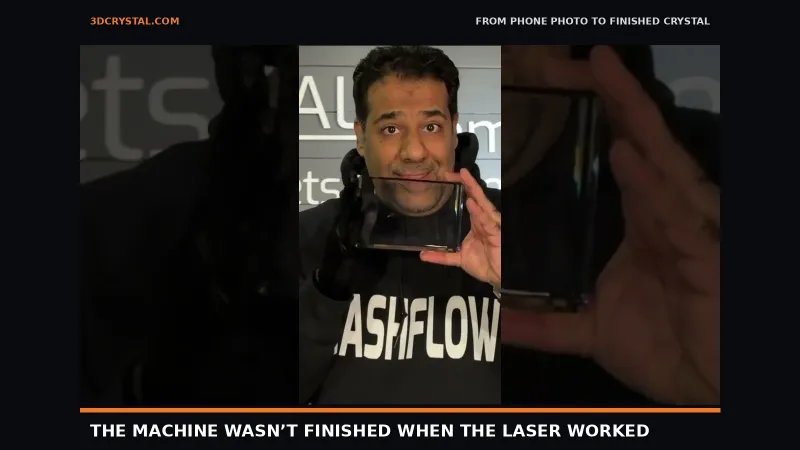




Riyaz Datoo stopped an acceptable performance because an unfamiliar product needs more than a technical explanation. It needs a reason for people to look up.
The take ended, and Riyaz Datoo did not try to rescue it. “Okay, it was all right,” he said. “Wasn’t the best.”
He had been trying to keep pace with an audio track. The timing felt wrong. There was a sigh, then laughter, but the judgment stayed firm: “This needs to be done very, very well.”
That standard was about more than performance. Datoo was attempting to explain a business built around subsurface laser engraving—technology that places thousands of tiny points inside crystal to create a dimensional image. For someone who has never held one of these pieces, the usual product shorthand is missing. A photograph is familiar. A crystal block is familiar. A portrait suspended inside one is harder to understand until you see depth appear as the object moves.
The challenge, then, begins before the specifications. First, you have to earn enough attention for the product to make sense.
An unfamiliar product needs a first act
Datoo’s working phrase was that 3DCrystal was selling entertainment. He was speaking to entrepreneurs, and the word was practical rather than theatrical. A well-presented demonstration gives a passerby a reason to pause. That pause creates time to notice the engraving’s depth, ask how a photograph becomes three-dimensional and imagine whose picture might belong inside the crystal.
The same principle already shapes the company’s advice on merchandising. Proper lighting reveals internal detail; letting someone hold and turn the crystal makes its dimensional effect easier to read. Presentation is an access point to the product. Without it, the object can be present while the idea remains invisible.
Advertising has a similar job. A list of technical features may matter later, especially to an operator evaluating equipment. At the beginning, the audience needs a clear transformation: a phone photograph becomes dimensional data, then an image engraved beneath the crystal’s surface. Once that sequence is understood, the questions about software, hardware, training and workflow have somewhere to land.
The edit before the explanation
The revealing part of Datoo’s reset is how quickly he edits himself. He does not blame the track or settle for a usable version. He identifies the failure—he cannot keep pace—then tries to rebuild the rhythm around a progression from action to attraction, reaction and transaction. The words tangle. He corrects them. Then he calls for another take.
This is founder-led marketing at its most useful: the person closest to the product hearing, in real time, where an explanation loses its audience. The imperfection is valuable because it exposes the work normally hidden inside a polished message. Clarity is not simply written. It is performed, tested and cut when it fails to carry the idea.
There is also restraint in stopping. Entrepreneurs are often encouraged to ship whatever is good enough. That instinct is sensible when polish becomes procrastination. It is less helpful when the material is the first bridge to an unfamiliar product. If the timing buries the idea, finishing the take does not finish the job.
Make the transformation worth watching
The current JetMini system carries the same thinking into the product experience. 3DCrystal presents it for event, kiosk and retail settings, and its transparent filtered door lets the engraving process remain visible. The company also connects the machine with Cockpit3D, its photo-to-point-cloud software, and provides training for operators. Those choices give a business owner more than a machine to describe: they create a sequence a customer can follow, from image and preview to the engraving taking shape.
Visibility matters because a personalized object begins as a promise. The customer knows the photograph but cannot yet inspect the finished crystal. A useful preview helps make the proposed composition understandable. A visible production process adds another moment of discovery. The finished piece then has a history its owner has partly witnessed.
None of that removes the need for judgment. Photographs still need appropriate composition, crystal shapes affect the available space, and a demonstration still needs someone who can explain what the customer is seeing. The advantage is coherence: 3DCrystal develops the hardware, Cockpit3D software and training as connected parts of the experience, so the operator can learn one story and carry it from first look to finished object.
The take that was merely all right never became the point. Stopping it did. Datoo recognized that the audience’s attention was part of the design, just like the image, the crystal and the laser path. For anyone learning how to market a 3D crystal business, that is the useful test: can a stranger understand the transformation before the explanation becomes a lecture?
3DCrystal’s current JetMini page shows how the company presents that transformation for events, kiosks and retail operators. The best place to begin is the whole customer journey—what they notice, what they can see and when the object finally makes sense.
Source video
What actually happens on set 🤫 #behindthescenes
Source note:
Reporting also draws on 3DCrystal’s JetMini product page and its merchandising guide.